top of page


ON THE NET
NAUTICAL MICRO MUSEUM
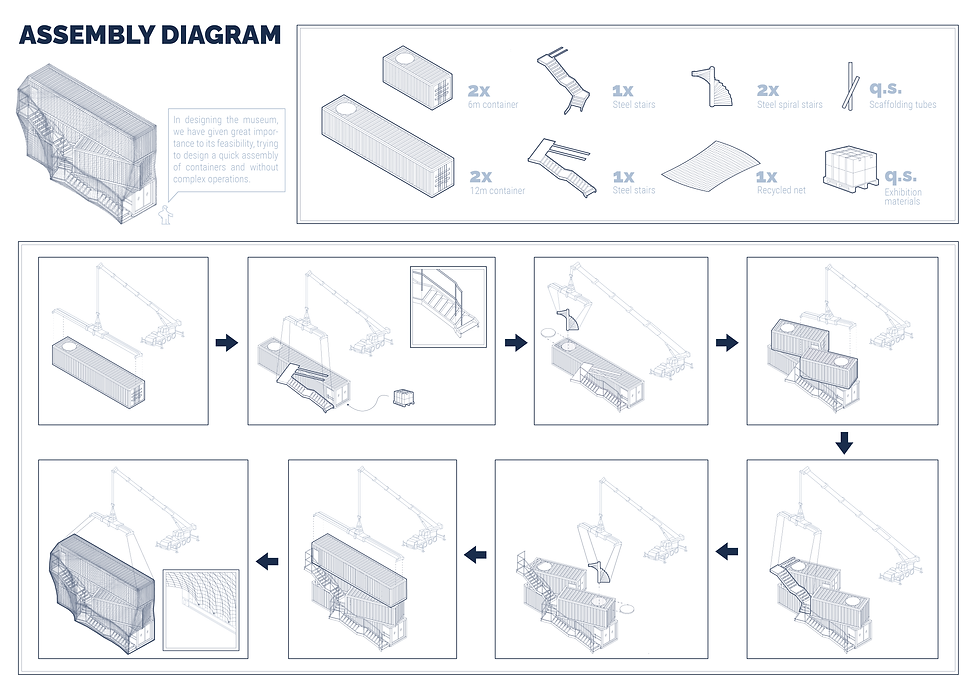
On The Net aims, through the concept of 'ready-made', to protect marine heritage by giving new life and meaning to nautical waste. This three-level structure is designed to provide an engaging experience crossing tradition and innovation. The ease of assembly-disassembly and the thematic division of the containers allow the reconfiguration of the overall layout, adapting to various needs.
TYPOLOGY
LOCATION
YEAR
DESIGN TEAM
Temporary musem
//
2022
Giuseppe Marrone, Davide Angeletti,
Francesco Pio Angelilli

ON THE NET
NAUTICAL MICRO MUSEUM
The project originates from the concept of ready made, term generally used to describe a work of art obtained from objects mostly belonging to evereyday reality.

1/1
In our case, we mean what comes back from the sea, which becomes a work of art once taken and placed as it is in a different situation than that of use.
The idea of giving dignity to common objects found, such as nets that are no longer used for fishing and are left in ports around the world, which are chosen and recycled as ecological skin from the external cladding of the museum, becomes an act of love for the sea and respect for the environment, as well as that nets are part of the collective imagination that promotes the understanding of the project itself as a maritime museum.
The final configuration of the museum is conceived to maximize the functionality, thus creating a logical path concerning the different functions given to the containers. In that way, we ended up with a three-layer configuration, where the visitor experiences the tradition (first container with the historic iconic models), the evolution (second and third containers with the timeline), and the innovation (fourth container with the current production) of Baglietto.


Together with the functionality, the project is conceived also in relation to its feasability, as quick and easy to assemble, without any complex operations or installations techniques.


1/3
The project also foresees a configuration on four levels. In this case stability is guaranteed by a system of tie rods anchored to the base container.

1/2


bottom of page